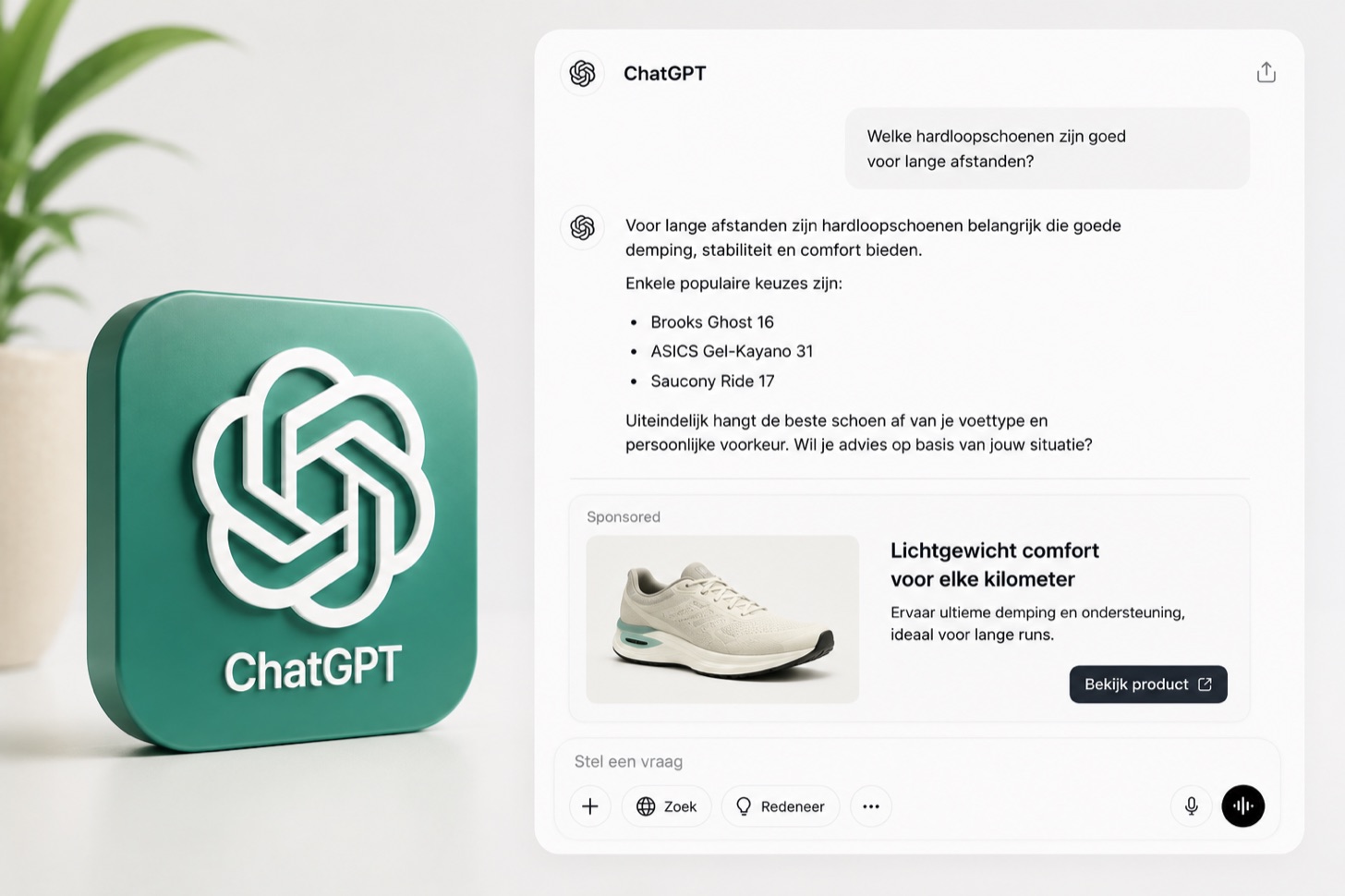
OpenAI has expanded ChatGPT Ads to 31 European markets, the Netherlands included. Since Monday 24 August 2026, Dutch users of ChatGPT Free and ChatGPT Go have seen ads below the answers. Since 31 August 2026, Dutch businesses can also buy the ads themselves through OpenAI's Ads Manager.
- ChatGPT Free and ChatGPT Go show ads to Dutch users, below the answer and labelled as sponsored.
- Dutch advertisers buy in themselves through the Ads Manager, with a minimum daily budget of €15 per campaign.
- Ads in the EU run without personalisation; targeting is based on conversation topic, approximate location, device type and language.
OpenAI announced on 18 August 2026 that ChatGPT Ads are expanding to 31 European markets. Since Monday 24 August, Dutch users of ChatGPT Free and ChatGPT Go have seen ads below the answers.
What are ChatGPT Ads?
ChatGPT Ads are paid ad cards that appear below ChatGPT's answer, labelled as sponsored and visually separated from the generated text. An ad card contains the advertiser's name and logo, a title, a short text, an image and a link to the advertiser's website.
The advertising system is separate from the model that writes the answer. OpenAI states that ads don't influence the content of answers and that advertisers get no access to conversations. Buying a placement therefore doesn't produce a recommendation in the text.
OpenAI started the advertising pilot on 9 February 2026 in the United States. Canada, Australia and New Zealand followed in April, the United Kingdom and Japan in May, South Korea in June and Mexico and Brazil in August. With 31 markets, the European expansion was the largest so far.
When do ChatGPT Ads appear in the Netherlands?
Dutch users have seen ads in ChatGPT since Monday 24 August 2026. OpenAI published the announcement on 18 August and named the Netherlands in it.
The 31 markets consist of the 27 EU member states plus Norway, Iceland, Liechtenstein and Switzerland. That brought the total number of markets with ads to 40 at that point.
The number of people ChatGPT Ads can reach is large. Over the six months up to and including March 2026, OpenAI reported an average of 159.1 million monthly active users of ChatGPT Search in the European Union. According to an estimate by SimilarWeb, published by Emerce, around 4.8 million Dutch people use ChatGPT at least monthly. Not all of those users see ads: the actual reach consists of the share that uses ChatGPT Free or ChatGPT Go.
Who sees the ads and who doesn't?
Ads appear only for users of ChatGPT Free and ChatGPT Go. The Plus, Pro, Business, Enterprise and Edu plans remain ad-free.
Three groups also stay outside the advertising system:
- Minors - OpenAI shows no ads to accounts it determines belong to someone under 18.
- Temporary chats - no ads appear in Temporary Chat.
- Paying subscribers - upgrading to Plus removes all ads.
For the Dutch market this means the reach coincides with the free and cheapest tier within ChatGPT. ChatGPT Go costs €8 per month in Europe, Plus €23 per month and Pro €229 per month. Anyone who wants to avoid the ads without paying chooses a variant of the free plan with fewer free messages per day.
For the B2B market, a concrete limitation follows from this. A decision-maker who uses ChatGPT daily for work is often on a paid or business plan and therefore sees no ads at the moment.
Can Dutch businesses advertise in ChatGPT yet?
Dutch businesses buy ChatGPT Ads themselves through a self-service environment. OpenAI opened that environment on 31 August 2026 for all 31 European markets where the ads run, the Netherlands included.
The ChatGPT Ads Manager is the self-service environment where an advertiser creates campaigns, sets budgets and reviews results themselves. That environment opened in May 2026 for American advertisers and has been open to Dutch businesses since 31 August 2026 via ads.openai.com.
A lot of coverage lumped two things together at launch. The first, display to users, began on 24 August 2026. The second, buying by advertisers, followed a week later on 31 August 2026. Articles from that first week therefore still report that buying yourself isn't possible in the Netherlands.
What do ChatGPT Ads cost?
ChatGPT Ads supports two buying models: cost per thousand impressions (CPM) and cost per click (CPC). OpenAI also expanded the platform with conversion optimisation, which lets a campaign steer towards a business goal instead of impressions or clicks.
Three measurement components come with the platform:
- OpenAI Pixel - records actions on the advertiser's website after a click.
- Conversions API - sends conversion data server-side from your own infrastructure.
- External measurement integrations - connect results to third-party measurement providers.
That second component ties directly into a measurement setup you probably already know. In why server-side tracking is essential for Google Ads you can read how a server container passes conversions outside the browser; OpenAI's Conversions API works on the same principle. Anyone already running that setup for Google Ads doesn't need to build a second infrastructure alongside it for ChatGPT Ads.
What is the difference between ChatGPT Ads and Google Ads?
The difference is in the moment and the unit you buy on. Google Ads buys visibility at a search query of a few words. ChatGPT Ads buys visibility during a conversation in which someone explores options, compares alternatives and reaches a choice.
Three practical differences:
- No keyword auction in the classic form - targeting starts from the conversation topic, not from an exact search term with a match type. Advertisers provide context hints: descriptions of the conversations their offer fits.
- One placement per answer - the ad block sits below the answer, not in a list of ten results with competitors around it.
- No second spot on the same page - in Google you appear with an ad and an organic result on one page. In ChatGPT that second spot doesn't exist: there is one answer, and your brand only ends up in it if the model pulls it from its sources.
That last point deserves attention, because being named in the answer costs no advertising budget and carries through in every conversation, including for Plus, Pro and Business users who never see an ad. Becoming a source in an AI answer follows different criteria than a position in the search results. In from rankings to citations: how SEO and GEO work together in the AI era you'll find the four criteria on which AI systems select sources, including the role of E-E-A-T and direct answer structure.
Which privacy rules apply in the EU?
Ads in ChatGPT run without personalisation in the European Economic Area and Switzerland. Targeting is purely contextual, based on four signals: the topic of the ongoing conversation, the approximate location at city level, the device type and the language. Custom audiences based on customer lists (Custom Audiences) therefore don't work for campaigns targeting the EEA or Switzerland.
Personalised ads require prior consent in the EU. If a user gives that consent, OpenAI uses signals from the broader ChatGPT experience, including saved memories and recent chats, when selecting an ad.
Refusing consent doesn't remove the ads. Refusing changes which ads a user sees, not whether a user sees ads.
For advertisers, a concrete obligation follows from this. OpenAI writes in the documentation that conversion data is only forwarded when the law permits it, after clear information about the data collection and after obtaining consent. The GDPR and the ePrivacy rules continue to apply in full, and responsibility for the consent process lies with the advertiser.
How do you prepare for ChatGPT Ads?
The advertising landscape in ChatGPT is developing fast. In just over six months, ChatGPT Ads grew from a pilot in the United States to a channel that businesses in dozens of markets buy themselves, including the Netherlands. OpenAI also keeps adding new features, such as AI tools that draft ads based on a landing page. Visibility in AI answers is therefore becoming a fixed part of the marketing mix, both paid and organic.
Three things can be prepared before you start a first campaign.
- Check your product data. Prices, stock, shipping costs and structured data determine how well an offer can be read in an AI environment. An AI answer places providers side by side more often than a search results list does.
- Get your conversion measurement in order. Assessing a new channel calls for measurement comparable to that of your existing channels. Server-side measurement is part of that, and becomes more important the more you steer on the outcomes.
- Do a baseline measurement of your AI visibility. Record in which answers your brand is currently mentioned and in which it isn't. A baseline measurement later shows whether those mentions shift now that ads sit alongside the answers.
Want to know where your brand stands now in AI answers and whether ChatGPT Ads is a worthwhile test for your offer? We're happy to walk through it with you, no obligations, just concrete insights.
Frequently asked questions
Are ChatGPT Ads available for purchase by Dutch businesses?
Yes. Since 31 August 2026, Dutch businesses buy ChatGPT Ads themselves through OpenAI's Ads Manager.
Does an ad influence the answer ChatGPT gives?
No. The advertising system is separate from the model that generates the answer. An ad appears below the answer, labelled as sponsored. Paying for a position in the text of the answer itself isn't possible.
Do all Dutch ChatGPT users see ads?
No. Ads appear only on the Free and Go plans. Plus, Pro, Business, Enterprise and Edu remain ad-free. Accounts that OpenAI identifies as belonging to a minor get no ads, and they don't appear in temporary chats either.
Do advertisers get to see my conversations?
No. OpenAI states that conversations remain private from advertisers and that the company doesn't sell customer data. In the European Economic Area the system also runs without personalisation, with targeting on conversation topic, approximate location, device type and language.
Do ChatGPT Ads replace my Google Ads campaigns?
No. ChatGPT Ads is exclusively for users of ChatGPT Free and ChatGPT Go. Its reach is therefore more limited than that of Google Ads. ChatGPT Ads functions as an additional channel alongside existing campaigns, not as a replacement.