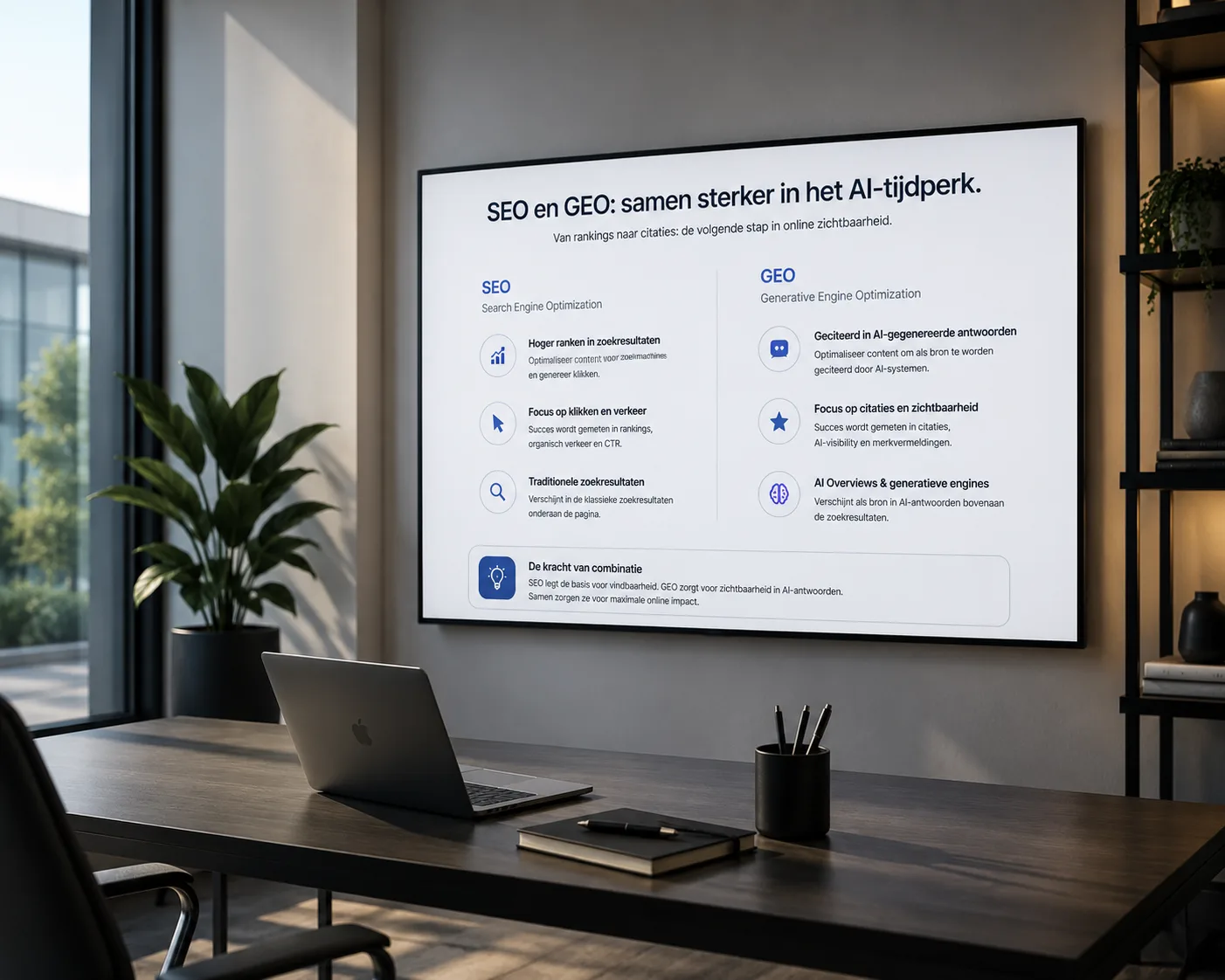
The search landscape is evolving. SEO remains the foundation, but in 2026 you add one central question to it: is your content also cited as a source in an AI-generated answer?
- AI Overviews are the new reality: SEO remains the foundation, but being cited by AI is just as important.
- For informational searches, clicks drop sharply, while visibility through citations actually grows.
- Content that gets cited often is clear, direct, well-structured and based on expertise, experience and trustworthiness (E-E-A-T).
Google AI Overviews are no longer an experiment. They are the new reality of search. Anyone who types something into Google increasingly gets a direct answer without having to click a link. AI systems refer users to more and more sources, and that traffic is growing rapidly.
That doesn't mean SEO has become irrelevant. It means SEO alone is no longer enough.
What is the difference between SEO and GEO?
With SEO (Search Engine Optimization) you optimize content so that a page ranks high in traditional search results. The goal is to generate a click from a sorted list. Success is measured in rankings, organic traffic and CTR.
With GEO (Generative Engine Optimization) you optimize content so that AI systems such as Google AI Overviews, ChatGPT Search, Perplexity and Gemini cite the content in generated answers. Success is measured in citations, AI visibility rates and brand mentions, not in clicks.
What do AI Overviews do to organic traffic?
On one hand, clicks drop. Pages that rank high for informational searches see an average of 58% fewer clicks (Ahrefs), and total organic search traffic for the average website falls by 21% per year. Logical: if Google already gives the answer at the top, a large share of searchers no longer clicks through.
On the other hand, visibility grows. Whoever is cited as a source in an AI Overview gains authority and brand awareness, even without anyone clicking through. The user sees your name, your brand, your expertise. That influences the decision process long before a link is clicked.
Important to know: AI Overviews appear mainly for informational and orientation searches. Those searching with the intent to buy or get in touch still largely see traditional search results. The drop in clicks therefore happens mainly at the top of the funnel. And precisely there, being cited as a source is the new measure of success.
How does GEO relate to SEO?
SEO lays the foundation for GEO. AI systems prefer to cite pages that already rank well in organic search results. A page that isn't findable is rarely cited, the two are connected.
The technical SEO fundamentals therefore remain as relevant as ever: fast load times, mobile-first design, crawled and indexed pages, structured data and internal linking. But several things that once seemed secondary now carry more weight. The parties that decide which sources are trusted are no longer only Google, and how and where your content is registered within the broader AI ecosystem is becoming increasingly relevant. Anyone who doesn't have that on their radar is falling behind.
What has become even more important is the content strategy:
- SEO content is written to draw visitors to the website.
- GEO content is written to be cited as an authority, even without the user ever clicking through.
Which criteria determine whether Google cites your content?
Google selects sources for AI Overviews based on 4 criteria:
E-E-A-T signals
Experience, Expertise, Authoritativeness and Trustworthiness are the leading quality criteria. Content with an author name and role, external source references, original data and demonstrable expertise scores significantly higher than anonymous, generic content.
Direct answer structure
AI Overviews prefer to cite content that answers a question directly in the first 1–2 paragraphs of a section. A heading that literally reflects the search query, followed by an answer.
Structured formatting
Use H2/H3 headings that reflect search queries, numbered lists for processes, tables for comparisons and FAQ sections.
Make clear what your page is about
AI systems understand content better when it's clear what a page is about. State that explicitly in the text, in the titles and in the technical markup of the page. The clearer the topic, the greater the chance of a citation.
Where do you start with GEO?
It starts with insight. Know where AI Overviews appear within your search landscape, because not every search produces one. Informational and orientation queries are the most sensitive, commercial and transactional searches much less so. Those two worlds call for a different approach.
From that insight you look at your existing content. Does it answer a question directly, or talk around it? That distinction is bigger than it seems. AI systems select on clarity and directness.
What's often forgotten: Google isn't the only place that counts. AI systems draw their sources from the entire web. Whoever focuses only on their own website misses part of a playing field that only keeps growing.
The details, which pages you tackle, in what order and with what priority, that's bespoke work. And that's where our work begins.
Want to know where your website stands now and what the biggest opportunities are in your industry? We're happy to walk through it with you, no obligations, just concrete insights.
Frequently asked questions
Is GEO the same as AEO or LLMO?
The terms overlap. AEO (Answer Engine Optimization) focuses on answer engines such as Perplexity. LLMO (Large Language Model Optimization) focuses on LLM-based systems. GEO is the umbrella term.
Is traditional SEO disappearing?
No. AI Overviews appear in roughly 30% of Google searches. The remaining 70% works through traditional organic results. SEO is the foundation for GEO success.
Do I have to completely rewrite my existing content?
No, completely rewriting a page is usually not necessary. GEO mainly calls for a different way of optimising. Enrich existing content with clear, self-contained content blocks (chunking), answer search queries directly and ensure a logical structure. On top of that, pay more attention to reliable source references, citations, up-to-date data and demonstrable expertise. It also helps to add unique insights, practical examples and first-hand experience, so that AI systems are more likely to recognise your content as a reliable source. This way you can make existing pages suitable for both traditional search engines and AI search engines, without starting over completely.
Is GEO only relevant for large organisations with big budgets?
Quite the opposite. Small organisations often have an advantage in GEO. They have in-depth knowledge of a specific topic, and that's exactly what AI systems look for. A niche expert is cited more often than a generalist with a big marketing budget.